
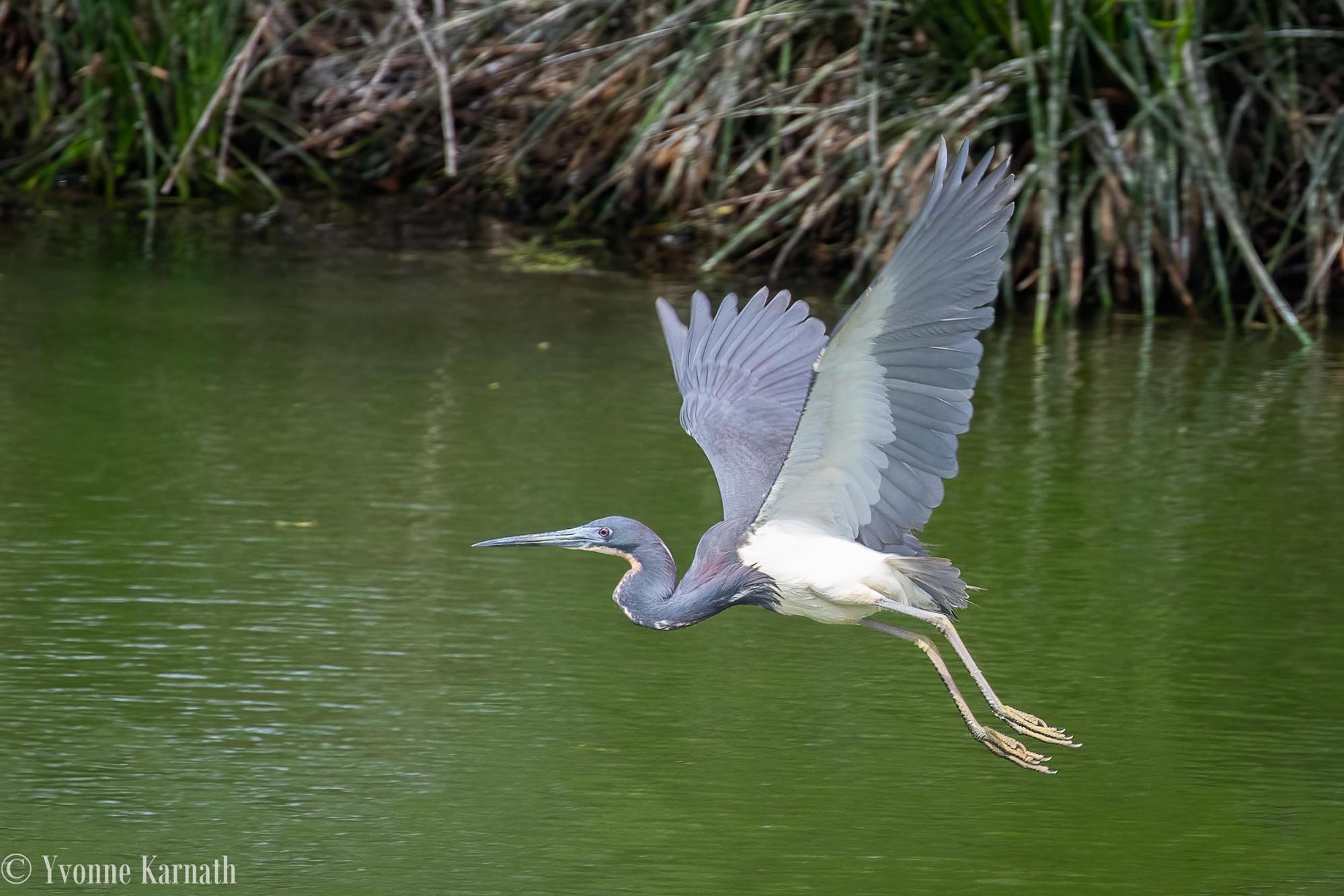
Tricolored Heron
Egretta tricolor
Compiled by Yvonne Karnath
If you spend most of your birding time around Travis County, you probably think of the Tricolored Heron as a coastal bird — and you would be mostly right. This long-necked, slender wader spends the bulk of its life patrolling the saltmarshes, mangroves, and estuaries of the Gulf Coast, where it is one of the most common herons you can lay eyes on. But each summer, particularly in July, August, and September, a handful of these strikingly colorful birds wander inland and turn up on the ponds, lakeshores, and river edges of Central Texas. When one of them shows up, it is hard to miss.
True to its name, the Tricolored Heron wears three colors at once. The upperparts, head, and neck are a soft, smoky blue-gray, often washed with lavender or purple in good light. A clean white stripe runs down the front of the long neck, and the belly and underwings are bright white — a field mark that separates it cleanly from every other dark heron in the region. Juveniles are noticeably more rust-colored, with a reddish-brown wash on the neck and wing coverts that fades over their first year. In high breeding plumage, adults grow long, filamentous blue plumes off the back of the head and buffy plumes down the back, the legs turn a striking pink, and the lores around the bill flash bright cobalt blue. It is one of the more transformed-looking herons of spring.

What really sets a Tricolored Heron apart, though, is how it hunts. Where a Great Blue Heron will stand statue-still and wait, and a Snowy Egret will hop and dash, the Tricolored Heron looks like it is rehearsing a ballet. It runs a few quick steps, freezes, pirouettes on one leg with the opposite wing held out, lunges, and starts again. Just before striking, it crouches so low that its belly often touches the water. The payoff is real: research summarized by the Cornell Lab puts the Tricolored Heron’s strike success rate at roughly 70 percent of attempts — quite high for a wading bird. Around 90 to 99 percent of what it catches is fish, especially small schooling species like topminnows and killifish, supplemented with crustaceans, amphibians, and the occasional insect.
On a sunny day at the edge of a shallow pond, you may also catch a Tricolored Heron doing something genuinely peculiar — hunching forward and arching its wings up and over its head like a small black umbrella. This is called canopy feeding. The shaded patch of water cuts the glare so the bird can see its prey, and it may also lure small fish into the apparent shelter. Reddish Egrets do something similar, but among Texas herons it is the Tricolored that you are most likely to catch in the act inland.
The bird most often confused with a Tricolored Heron is the Little Blue Heron. Both are dark, medium-sized, and elegant. The trick is to find the belly. A Little Blue is uniformly dark slate-blue underneath; a Tricolored Heron has a crisp white belly and white underwing linings that almost glow in flight. Juveniles complicate the picture — young Little Blues are entirely white, while young Tricoloreds are reddish-necked with that same white belly already showing. Reddish Egret, the other dark-bodied wader Texans see, is a chunkier, longer-legged bird with no white on the belly and a much more frenetic, drunken-looking foraging style.

On the range map, the Tricolored Heron hugs the coastline. It is a permanent resident along the Texas Gulf, where the Texas Breeding Bird Atlas describes it as abundant but “mostly coastal in estuaries, lagoons, swamps, and marshes within the Coastal Prairies.” It nests colonially on small islands and in coastal thickets, often alongside other wading birds. After the breeding season wraps up, juveniles and adults disperse — sometimes considerable distances inland — in search of fresh fishing water. That is the wave that washes a few birds into Travis County most summers.
Locally, the best odds run from July into September. If you would like to try for one in Travis County, the spots that have produced reliable sightings in recent years include the Hornsby Bend Bird Observatory ponds, the Colorado River downstream of Longhorn Dam at Pleasant Valley Road, Secret Beach at Roy Guerrero Park, and the pond at the Mueller Southeast Greenway across from Morris Williams Golf Course. Scan slowly along shallow muddy edges — a Tricolored Heron is usually the dark, slim heron that is doing the most moving.

One last bit of trivia worth knowing: until 1983, this species was officially called the Louisiana Heron. The American Ornithologists’ Union renamed it the Tricolored Heron to better reflect its range — which stretches from the southeastern United States through the Caribbean and along both coasts of Central and South America — and to highlight the field mark that makes it so easy to call once you have it in your binoculars. You may still hear longtime birders use the old name. Either way, when one shows up at a Central Texas pond in late summer, it is a small coastal vacation that comes to us.
Sources:
https://www.allaboutbirds.org
https://ebird.org
https://txtbba.tamu.edu/species-accounts/tricolored-heron/
https://www.audubon.org/field-guide/bird/tricolored-heron


